Elks Vendor Fair Saturday, March 8th from 9am to 2 pm

The Benevolent and Protective Order of the Elks (BPOE) takes on a very active task in supporting communities locally, throughout Arizona and on a national level.  Elks Lodge #335, located on North 32nd. Street, is a hidden gem right here in our own neighborhood. This Lodge has many members whose mission is to help build a strong community.  These members contribute and support such local programs as Veteran’s Dinners;  The Thanksgiving Basket Program which provides food baskets for Veterans and their families; Dinners for our local Law Enforcement Officers and Fire Fighters; Drug Awareness Programs; Scholarships; Children’s Back to School Program providing new clothing and supplies for children; Young Readers Program; and programs that provide several local schools with dictionaries for their 3rd grade classrooms.

Their newest program, the Single Parent Relief Project, will offer support and assistance to single-parent families in need.  On The First Saturday of each month these families will be welcomed into the Lodge for a hearty breakfast and each will be assisted with food, baby supplies, school supplies and more. The objective will be to assist 20 families in 2014.

Please join us on Saturday, March 8th  from 9am to 2 pm  for our Vendor Fair, featuring food trucks, arts and crafts booth, a DJ and Door Prizes.   Free Admission and Parking at Elks Lodge #335, 14424 N. 32nd. Street. 

Contact Joe Carroccio for further information 480-329-3957

Why Selling in a Balanced Market is actually Good

One of the most common questions that would-be sellers ask us is when is the best time to sell? The questions vary but generally sound something like this: “Isn’t it best to sell in a seller’s market?” “Now that the market has shifted to a balanced/slight buyer’s market isn’t that a horrible time to sell?” Actually, if you have a choice (and often we have no choice – selling is often driven by circumstances not under our control) selling in a balanced market may be one of the best times to sell. Here are some of the reasons we believe sellers should consider this time to get their homes on the market:

1. Price appreciation flattens in a flat market. We know this sounds counter-intuitive but bear with us as we explain this. Prices are always a trailing indicator in housing. This means that anywhere from 9-18 months after something happens in the market – it is reflected in prices. The market started shifting away from a seller’s market in June 2013 when buyer demand began withering. Pricing runs on fumes for a while before evaporating. That “fume” stage is a sweet spot for sellers because prices are gently floating up, word is not really out on the street that the shift has occurred, and the big future price appreciation that sellers would miss out on if they sell in a seller’ s market – is not being missed. In other words, when prices go flat – sellers are selling at a peak.

2. In a balanced market, builders remain conservative, adding only a trickle of new homes. In a strong seller’s market, builders – just like any other seller – want to cash in on the strong appreciation. This starts adding more and more supply of homes – which as we observed in 2005 – and can create a bubble that “pops” when supply becomes glutted. As we have seen, recovery can be painful and slow after that pop.

3. In a strong sellers market, successful sellers become “homeless” when they are unable to find a home to buy. Sellers who are buying locally, enjoy the power a seller’s market provides them as a seller, but then find themselves stressed and panicked when trying to buy in that same market. This can lead to poor buying decisions and huge concessions to obtain a home.

4. Less problems with low appraisals. An often overlooked problem in a strong seller’s market is the financing piece. Lenders base all their numbers on the appraised value of a home. In a rising market, prices begin escalating over yesterday’s pricing. While sellers often get a higher than expected yield at point of contract, they can find themselves giving that money back to the buyer when the appraisal comes in low or risk the transaction cancelling.

5. In a balanced market there are still enough buyers around to still sell without great difficulty. A balanced market means just that -buyers and sellers are in equal supply. So although the “feeding frenzy” may not be present, the buyers are still viewing and buying properly marketed properties in sufficient quantity to make selling a relatively easy and fast process.

How long will our market stay balanced? That is the million dollar question. At the moment, we see nothing dramatically pulling the market one way or another . But as Sir Isaac Newton so brilliantly said “ I can calculate the motion of heavenly bodies, but not the madness of people.” As always, we will do our best to keep you informed on the Valley’s volatile housing market.

Will This Be a Happy New Year?

2014 is not starting off with a bang. At least not yet. The 4th quarter of 2013 was one of the lowest for pending sales in many, many years (2008 to be exact). This has contributed to a dramatic shift from what was a red hot seller’s market into a balanced market and even – in many areas of the valley – a buyer’s market.

To my knowledge no major economist is predicting anything dire for the valley. Truthfully, it is not necessary to know what they are saying to see what is happening with residential real estate prices. There are only four factors that regulate the price of housing. Supply and demand, monitored by fear or greed. There are many factors that contribute to which direction the market or a market segment is heading. Probably the most important number that determines the state of the market is the current absorption rate – how long the current supply would last if the rate of sales stayed the same and no new inventory came on the market.
A perfectly balanced market is six months – actually, a range of 5 to 7 months. With a six month supply there is no price movement and neither buyers or sellers have an advantage. If we go back many years and look at what is a “normal” level of inventory we see that it is 4.5 months. A 4.5 month supply will create very gentle upward pressure on prices, about the amount necessary to keep housing in step with normal inflation. Get down to a three month supply and you can see the prices rising – it’s a “seller’s market”. Less inventory than that is a “red hot seller’s market”. Around an eight month supply you have a “buyer’s market”. These numbers are true in any market, any market segment, and in any geographic area.

As you can see, from the current chart (chart 1), the months’ supply varies considerably depending on the price range. This number also varies greatly based on geographic location. The current number for the valley (all price points and areas) is 4.9 months supply. On the inset (chart 2) you can see the recent range of the valley wide months’ supply has gone from a 5.9 months in Jan 2011 to a low of 2.2 months supply for June 2012.

One interesting observation is that the “failure rate” for listings in the MLS tends to go up sharply when the inventory level rises (i.e. homes that don’t sell). Home sellers who have highly experienced agents who can accurately read the market do not suffer from their home not selling. It is possible to successfully market a home in any market.
So what will the spring buying season bring this year? Doom and gloom or a balanced market? Truthfully, we don’t know. We suspect balanced. But, the first sign of market strength (and yes weakness) is pending sales. If we see increasing sales this spring, the cooling phase of the market is over. If not, then we are likely to have a very subdued spring season that could last more than just a season.

Weak or strong, as always, you will know just as soon as we do.

Market Roulette

2014 is beginning quite differently than 2013 did. 2013 entered as an overheated seller’s market –with inventory unusually low and properties coming to market at one of the lowest rates in history. Fast forward to 2014 and we find a very different market. Only a few geographic areas in the valley are still in a seller’s market (i.e. a market where demand exceeds supply) while most are in a buyer’s market. Knowing the market in which you are attempting to buy will guide you on how best to negotiate – can you demand price flexibility or should you expect to pay “market value” or more?! Here are the markets currently by area:
The following are still in a seller’s market: Sun Lakes, Sun City West, Anthem, and Paradise Valley.

The following are in the balanced zone: Chandler, Glendale, Scottsdale, Litchfield Park, Arizona City, Avondale, Mesa, Sun City, Apache Junction, Cave Creek, El Mirage, Phoenix.

The following are in a buyer’s market: Peoria, Tolleson, Tempe, Fountain Hills, Gilbert, Goodyear, Laveen, Gold Canyon, Surprise, Casa Grande, Buckeye, Maricopa, Queen Creek & San Tan Valley.

As always, there are variances in individual neighborhoods, as well as price brackets. A Realtor provided supply / Demand Analysis will show which is which.

The only thing that remains the same is change

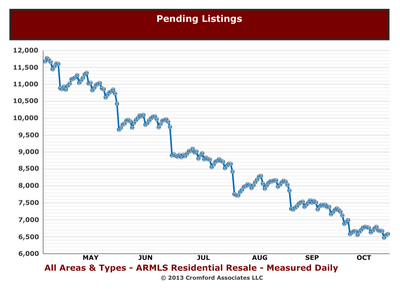
As 2013 begins to wind down, our real estate market seems to be following suit. As we reported last month, demand has dampened significantly. Many observers will attribute this to the “seasonal effect” – meaning that the market has its peaks and valleys every year in a somewhat predictable pattern – the fall season being one of the valleys. They would be wrong; this is beyond the season. This fall, pending listings are falling faster in 2013 than any fall since 2000. To restate again what is causing the steep drop in demand, as much as the psychology of buyers can be generalized, here is what we believe is happening:

1. Interest rates escalated rapidly (as a point, rates rise rapidly but drop slowly). The fact that they have now stabilized for the time being seems to be offering only a small amount of comfort to buyers.

2. Two years of price increases has made our fame as “one of the best bargains in the country” suddenly no longer true. The fact that our market is still below the hard cost of commodities (roofing, concrete, drywall, etc.) and below the inflation/appreciation trend line of the last 12 years seems, at the moment irrelevant to buyers.

3. Investors are dropping out of the market. Currently investors make up around 19% of the sales. This is the lowest percentage since June 2010. Even just a year ago the number was closer to 29%.

4. The economy, government shutdown, and threats of government debt defaults aren’t exactly instilling confidence in the buying public. When the future seems uncertain, the emotions that run the financial markets can turn from greed to fear. It would seem that fear is dominating at the moment.

So what will fix the demand problem? Well, usually price would be the answer to lowered demand. In this case, we are not expecting to see any major pricing drops. More likely than any significant pricing drops is that price appreciation is likely to come to a halt until the demand issues recover.

What is the message to sellers? We are now in a balanced market. If you have been waiting for prices to peak or flatten before selling – this is likely the time. A balanced market also means sellers may be required to be more flexible in contract negotiations, the days of multiple offers may become scarcer, and the choice of agent will matter more than ever.

The message to buyers? Ease your fears. Rates and home prices are both still under market norms. Choices of homes are finally becoming abundant and that should be welcome news for choice starved buyers.

How long will this last and what will 2014 bring? Whatever it is we will do our best to keep you posted on this ever changing market. What never changes for us is our deep gratitude to our clients who have allowed us to serve them this year and years past. We hope you have a joyful holiday season!

Buyers hit the Pause Button

Demand for homes has been a complete non-issue in the valley for the last 3 years – so much so that the current drop in demand has come as a bit of a shock to anyone observing it. Supply has been beyond abundant through our recent distressed market.  Banks were overwhelmed with the volume of short sales and foreclosures swamping them – and unlike “normal sellers” the banks had to sell – no matter the price.  The number of listings on the market hit all-time new highs.  In short, the only headline was supply, supply, supply.  As the supply of homes surged, so did demand. Investors swarmed Phoenix to pick up bargain basement values that were everywhere. Tax credits lured the first time home buyers to the market. Net migration was up (i.e. more people moving in to the valley than were moving out). New builds were effectively at zero – meaning no new supply was being created.  Sellers were swamped with multiple offers, many cash.  It seemed like that party would never end.

Of course the only thing that stays the same is change.  So the pendulum has swung (however temporarily) and now the real estate headline has switched to the drop in demand.   This drop is inciting the “doom and gloom” gang to heat up once again (although we cannot recall them ever really cooling off).  These are the same people who refused to believe there was no “shadow inventory” being stashed by the banks which would “be released” and crash the market.  That theory never materialized, but gave birth to the newest version: demand is down and therefore the “recovery has stalled”.  Like the earlier rumor, we don’t believe there is any basis to this theory.  As Michael Orr so brilliantly states:

In the normal world, no market improves every month without a rest now and then. There are always changes going on, and we are way overdue for a cooling off.

A move towards normality should not be regarded as a sign of impending doom, just a sign of impending normality.

A move towards normality does not mean prices will come down. Unlike the stock market, prices almost never move downwards in a normal real estate market. Sellers only lower their price expectations when very desperate. Desperate times do occur a few times per century, but they are very rare. For a while in 2004 and 2005 we forgot that they could ever happen. Now the public knows all too well they do and consequently expects prices to drop at any moment, even when it is least likely to happen.

So if “everything is fine” why is the market stalling? Affordability and Psychology. Buyers have been hit by a double whammy – rising prices and interest rates.  Affordability in an area is monitored by pricing, interest rates, and income.  It is a pretty safe bet that income has not jumped much in the last 2 years – and certainly no where near the level that prices and interest rates have jumped.  So although local real estate is still (in our opinion) undervalued, affordability has taken a hit.  The fact that long term trends for “normal interest rates” fall around 8%, placing today’s rates at well below normal, the psychology of affordability has kicked in.  Buyers, hoping that either rates or pricing will come down, move to the sidelines as emotion overtakes logic.  The bulk investors, the hedge funds, have done the bulk of their purchasing here and that also adds to the drop in demand.  This should be good news to the “normal” buyer who often lost out when competing with these “professional” buyers.  Michael Orr further explains:

“Buyers probably need some love and to be treated with more respect. There is still a long term shortage of supply and prices are unlikely to come down, but ordinary buyers need more convincing of the virtues of stepping into the market at this time. Large scale investors are backing off. They have made the bulk of their purchases already. If the market is to run at full speed we need more owner-occupier buyer motivation to overcome the sticker-shock…

Going forward, we should expect buyers to feel like they have the option to say no. More marketing and selling is going to be required to maintain the speed of the recovery. Without that, the recovery will probably slow and price increases will moderate. We are still in an early phase of a long term recovery, but right now home buyers will need much more convincing of that fact.

This is probably a temporary phenomenon, like the lull in demand after the tax credit expired in 2010. However at the moment it is still unclear how long it will last

What does dropped demand do to supply? One would suppose that the lessened demand would create a large surplus of supply, but the story is more nuanced than that.  Michael Orr further explains:

So far in September we have only 2,988 new listings added to ARMLS. That is the lowest number in 13 years. However 1,848 of those listings are priced between $150,000 and $500,000. That is the largest number for this period since 2009 and it is 29% more than last year. Between $250,000 and $500,000 we have the most new listings during this early part of September since 2008. So supply is growing in the mid-range and in contrast the low-end under $150,000 has seen new listings drop by 40%. I’m sure a lot of buyers wish there were more homes available under $150,000. Above that mark buyers now have a lot more choice, but can they afford them?

What does this mean for home sellers?  If the trend towards normalcy continues, we can expect fewer offers, slower price appreciation, and more competition for buyers.  Sellers, who have been waiting for price appreciation to peak, might consider if that time is approaching.  Buyers who are waiting for lower rates and price drops, are likely to be disappointed and should get off the sidelines.

Doesn’t “normal” sound like a place we all want to be?  As always, we will strive to keep you apprised of the ever changing market.

Waiting For the “Good Time” to Buy

You are thinking of buying a home – but not sure if now is the “right time”.  If you are waiting for the perfect time – it was May of 2011. It isn’t coming back.  I fully understand that numerous national experts are blathering on about a “bubble” and the big problems that will result from all of the institutional investor owned homes in thePhoenixarea.  All of the people spewing this nonsense (even the ones wearing suits and who have a doctorate degree) have one thing in common: they have no actual grasp of the market and aren’t really very good at counting either.  Don’t rely on them to guide you on the decision to buy.  Did any of them tell you to buy back in May of 2011?  Nope.

Arizonaprices would need to rise another 48% to make a new all time high.  Foreclosures here (a meaningful LEADING indicator) are already below normal.  Short sales are falling fast.  The rate at which prices are rising is slowing as the market returns to normal.  Interest rates are no longer at record lows but still much lower than the average mortgage interest rate (8.6%) for the past 40 years.  A year or two from now, people who wait will say I should have bought back in the last quarter of 2013.

“Prediction is very difficult, especially about the future.”

~ Niels Bohr

Market Trends

Now that we are past the spring selling season and into the lull that comes before the pre-holiday pickup, some interesting trends have appeared (at least to us who have been trend wonks for years).  In no particular order of importance they are:

Listing inventory is at long last climbing.  This year began with the lowest numbers since 2001 for new listings coming on to the market.  The previous winner for that honor was 2012 (the highest number of listings coming to market was 2006).  That has now shifted and the numbers are starting to climb.  While we don’t expect this year to set records for new inventory – it would appear the shortage of homes for sale is starting to improve.  This is primarily good news for buyers who have been “house starved” for quite some time.  For sellers it means price increases are flattening as we move towards a more balanced market.

Move to a more balanced market.  While listings are finally beginning to climb (supply), the bigger story is in the drop in demand. At the moment demand still exceeds supply by a wide margin, but the gap between them is smaller than it has been since August 4, 2011.  The exact why of the dropping demand is not as easy to assess.  Is it the interest rates rising, the fact that “bargains” are evaporating, the small pool of homes available under 150K, or a combination of them all? Whatever the reason, the fall in contract activity is certainly affecting the lower price ranges more than the higher ones.

The number of pending listings today is down a massive 28% from last year’s August.  Scottsdale is the clear exception among the larger cities. There is an improving trend in the luxury market which is also affecting Paradise Valley. The slowdown in demand is most apparent in the close-in cities such as Phoenix, Avondale, Tempe and Glendale and in the Southeast Valley – Gilbert, Chandler and Queen Creek. These had been riding high until June. Cities on the fringes had slowed down many months ago … It is possible that some buyers have decided to drive until they qualify and diverted their attention from the inner locations to the fringes where the same house can sometimes be bought much more cheaply. Active Adult cities like Sun City, Sun City West, Sun Lakes are seeing exceptionally low supply for the time of year and are not part of the trend discussed above. The gap between supply and demand is widening in these locations. El Mirage and Litchfield Park are also bucking the general trend….

We note that the greatest decline is in the price ranges below $150,000. Above this mark the numbers are not so very different from last year and above $800,000 they are much higher than last year. The luxury market is seeing strengthening demand while the demand at the lower end is down substantially. Some might argue that the pending listings are down because supply is very low, but it was very low last year at the low end too.

Lending practices.  Ever since the “mortgage meltdown” of 2007, lending has been constricted.  The impact of lending upon the real estate market cannot be over stated.

Future appreciation will depend very much on how lenders change their mortgage guidelines. At the moment they seem to be warming up to jumbo loans and are making them both easier to obtain and available on more attractive terms. At the other end we haven’t seen much improvement in the flow of loans to first time home buyers. The significant increase in mortgage insurance costs for FHA loans has put a distinct dampener on this segment of buyers. We remain convinced that the recent surge in interest rates has had only slight impact on the market with some buyers stopping to rethink their strategy while others have been given a greater sense of urgency. …If President Obama’s initiative to make loans more freely available to new-home buyers is effective this will probably overcome the slowing effect of the higher interest rates. However if it is not effective, or comes too late, then we would expect the market to continue to cool down over the coming months… On balance, not much changed. As usual it is the availability of finance which is important not the cost. So the luxury market has improved while low end demand has waned a little.

Cash deals. Cash deals are declining in Maricopa County. In July 24.4% of the money spent on homes and recorded with an Affidavit of Value was in all-cash deals. This is the lowest percentages since October 2009. The peak was February 2011 with 35.8%. If we count transactions rather than the total spending, the cash share in July was 29.3%, which is the lowest percentage since June 2010. The peak was again in February 2011 with 41.9%.

We still have a long way to go to get back to the old ways in which the vast majority of housing transactions were financed. Until January 2008 the percentage of cash transactions was usually no more than 12%. Since the end of 2008 it has never been less than 25%.

Which of these trends surprised us the most?  The push away from what seemed like what would be  a very severe shortage of homes for sale – towards the trend, that if it continues, would appear to result in a balanced market.  Stay tuned as these competing trends resolve.

All italicized quotes are from Michael Orr of the Cromford Report.

Russell & Wendy Shaw

(Mostly Wendy)

Institutional Investors Drive Our Market??

From Michael Orr:

According to most of the media. the housing market in the USA is currently “dominated by institutional investors”. The largest of these (by far) is Blackstone (BX) which has about $60B in real estate assets under management. It currently owns about 31,000 single family homes in the USA with a total book value of about $5 billion. $5 billion sounds like a lot of money, but everything is relative. The total value of all homes in the USA is roughly $20 trillion. So Blackstone’s rental inventory represents approximately 0.03% of the housing stock value. Foreign buyers as a group are more than 13 times as significant as Blackstone. According to NAR’s reports, for just the 12 months ended March 31, 2013 foreigners spent $68.2 billion on US homes. The Chinese accounted for 18% of that number or $12.3 billion. Nobody (including me) is claiming that the Chinese are dominating the market, yet they spent more than twice as much as Blackstone’s entire inventory. Blackstone represents about 30% of all the institutional ownership, so the total value of all the single family homes owned by institutions is roughly $17 billion. This is only 25% of the value of all homes bought by foreigners in the period April 2012 to March 2013.

Large numbers seem to cause some people to lose their sense of proportion and form completely false impressions of reality. Many of them write blogs on housing and articles for news outlets. Many of these are  misrepresenting the state of the housing market right now. Their conclusions are bogus.

Home prices are NOT going up because of institutional investors. It is the other way around. Institutional investors are buying homes because their prices are going up. In other words – they are not stupid and can recognize an opportunity to own an appreciating asset and have their holding costs paid for by a third party – their tenants.

Home prices are going up because of chronic low supply. It is as simple as that.

There is no Inverse Correlation Between Interest Rates and Home Prices

From Michael Orr of the Cromford Report:

“There is no inverse correlation between interest rates and home prices. In the past, home prices have often gone up when interest rates went up and they have also gone up when interest rates went down. Home prices only go down in unusual situations when supply is well in excess of demand. Prices have fallen like this in the Phoenix area between 1989 and 1991 and between 2006 and 2011. Between mid 1989 and mid 1991, the fall in prices was about 9 to 10%. During this time 30-year fixed mortgage interest rates fell from around 10% to around 8.5%. No inverse correlation there.

Between June 2006 and August 2011 prices were also in a strong downward trend, though most of that decline happened between 3Q 2007 and 1Q 2009. Between 2006 and 2011 mortgage interest rates dropped from around 6.75% to around 4.5%. No inverse correlation there.

Interest rates went up sharply during 1994, during 1996, between 1998 and 1999 and between 2003 and 2006. Did prices go down during these time. No they did not, they went up just like the interest rates. No inverse correlation there.

During all these times the direction of home prices and the direction of mortgage interest rates were the same. At other times they can move in opposite directions. There is no clear correlation either negative or positive. The fact that the majority of people believe there is a correlation, does not change the reality.

Prices have moved strongly upward between August 2011 and June 2013. During that time interest rates drifted down from 4.5% to around 3.5% and very recently have moved back up to around 4%. There is little evidence that low interest rates had any major influence on the market pricing. Demand has been only slightly above normal during this time despite the very attractive interest rates. It was lack of supply that drove these huge price increases.

So now that interest rate have finally started to rise from a ridiculously low level, some people have said this is going to cause home prices to fall. There is no logical basis for this assertion at all.

When interest rates rise, this causes affordability to fall. However affordability does not equate to demand. Demand is one of the two key factors that influence prices, affordability is not. The highest demand we have seen in the past 30 years was in 2004 and early 2005 when affordability was extremely low.

In fact increases in mortgage interest rates often cause an increase in demand in spite of falling affordability. That is because many people expect the upward trend to continue, so they want to lock in the current rate by getting a mortgage now before it rises higher. This “sense of urgency” phenomenon is very real and has been observed many times in the last 60 years and confirmed by many experienced Realtors®.

Now if interest rates were to increase dramatically and suddenly, this could destroy the “sense of urgency” because people would immediately feel they were too late to make the move. I am talking of a jump from 4% to 9% or something of that nature. But is that really likely? I doubt it. The government likes to interfere with interest rates and they are unlikely to let that happen.

Gentle and predictable rises in interest rates will actually be good for the housing market because the rising gap between low and high rates will probably encourage lenders to be a little more flexible with their underwriting practices. Opening up the market to more people will have a much larger effect than the increase in their monthly payments. It’s no good being able to afford a mortgage payment if you can’t get approved for it.

Of course demand is not sufficient to determine prices. Supply is the other key factor. The foreclosure crisis has caused us to under-build new homes by a huge amount for over 5 years. This is still creating a supply hole that has been largely unrecognized by the general public. This effect is likely to dominate the market for a very long time, except in areas where the population is shrinking. Only the builders can create significantly more supply. It is not coming from lenders, it is not coming from landlord investors and it is not coming from ordinary homeowners. Ordinary homeowners and landlord investors usually involve homes that are occupied. So when they sell they do not create net new supply. The families or individuals living there move into a new home, often not too far away. This means they add 1 to supply and 1 to demand. The net effect is zero. Only when that home is somewhere other than Greater Phoenix do we see an increase in our supply. For the foreseeable future those people are likely to be outnumbered by the people who are moving here from somewhere else, who add 1 to demand and 0 to supply.

This housing cycle still has a very long way to run before it turns down again. None of the negative factors mentioned by observers recently have enough market power to overcome the dominant effect of the chronic supply shortage.”