As the year comes to a close, some interesting facts have appeared. First, we now have had one solid year of positive appreciation in the monthly average sales price per square foot on homes sold through MLS. It turned negative in August of 2010 and then turned positive again on November 30th 2011 which continued through 2012. Now, one year later, we’ve seen appreciation of around 28% – with the bulk of the gains occurring in the first half of 2012.
Normal sales continue to replace distress sales – even in the last 30 days moving from 60.8% to 65.1%. Wow, we haven’t seen that level of “normal†sales in five years! REOs dropped slightly to 13%. Short sales dropped more significantly from 26% to 22%.
What will 2013 bring? Markets can shift quickly as the last few years have shown. At this time it would appear that the rising prices will continue to lure sellers back in to the market increasing supply, investors are likely to continue to diminish as higher prices curb their appetite decreasing demand further, and we may find ourselves back in a buyer’s market in 2013. Stay tuned!
2012 Begins its Wrap Up
Now that we are in the waning days of 2012, it is time once again to review where we are and prepare for what will no doubt be another interesting year in  2013. After a rather sluggish summer, the market regained some velocity in the fourth quarter. Supply continues to build, although it is still well below average. Below $200,000 demand remains strong and we are still seeing multiple offers. Prices in this range continue to edge up. Not surprisingly, the highest appreciation rates have been occurring in those places where prices crumbled the most in 2007-2009 – primarily the drive until you qualify communities.   In contrast, higher priced homes have shown only a small amount of appreciation with just a few posting double-digit improvements such as – Carefree at 11.7%, Desert Hills at 13.9% and Tempe at 11.0%
The increasing prices are luring both sidelined sellers and even builders back into the marketplace. At some point, the increased prices will drive back the demand resulting in a balanced market. We do expect spring of 2013 to be a very healthy market for both buying and selling.
Probably the best summary of the 2012 market is stated most perfectly by Michael Orr of the Cromford Report:
“The change in price over the last 12 months is clearly impressive. There are very few occasions in which the average price per sq. ft. rises by 25%. The only previous time I know of is May 2005 to March 2006 and that was at the height of the bubble. A rise of 2.7% in the single month of September would also normally be startling, but we have got used to big numbers. When the market eventually gets back to normal we should expect to see 2.7% for a whole year, not a single month.
What we have seen is the “coiled spring theory” in action. Supply got extremely low last year but prices refused to react until the fourth quarter of last year. Now prices have moved substantially higher we are seeing signs of the market cooling. Supply is growing as sellers start to take advantage of the higher prices achievable. Some buyers have become discouraged by the amount of competition and higher prices and so left the market, resulting in some softening of demand. Sales volumes though ARMLS are well down. However, this is somewhat misleading because a large number of real estate transactions are happening outside of the MLS. Deals between investors, new homes sales, trustee sales, pocket listings and private sales add up to a significant volume which is missing from the MLS numbers but captured by the county records. “
For the 3rd Quarter, normal sales are now 59.5% of the market. The number of normal sales should continue to grow.  Short sales have stabilized at 30.17% of the market (and we expect them to be a slowly declining part of our market for the next couple of years). Happily, REO/HUD are now down to only 13.95% and are becoming almost irrelevant. On that note, you may remember last month we commented on Bank of America suddenly shifting gears by taking back into their inventory REOs rather than selling them at auction to investors. After 5 weeks of this, it appears that they have stopped that program. Go figure. We expect to see a small bump in REO product as these homes go to market but it still will have a negligible effect. The number of Notices of Trustee Sale inMaricopaCounty was 2,690, the lowest total since July 2007 over 5 years ago. This is all good news. Our hope is that by the end of 2013 REOs will be back in the “normal†range.
No matter what the new year brings, we will keep you posted on our ever-changing market. In closing, we wish to thank all of our wonderful friends and clients for your trust and for allowing us to assist you with your real estate needs. It is an honor to know you and to serve you. We are truly grateful.
Russell & Wendy Shaw
(mostly Wendy)
The Housing Market Marches On
Occasionally we write articles that don’t focus solely upon current real estate market conditions. This is not one of those times. The real estate market in the valley has been providing headlines since late 2004. Until the market fully returns to “normal†(it has been so long since a normal market we wonder if we will recognize it) we are no doubt destined to continue that focus. As always, our best source for market statistics remains the brilliant Michael Orr of the Cromford Report.
First, let’s begin with some numbers comparing September 2012 with September 2011:
*Active listings with no offers – 14,405 versus 19,216 last year – down 25% but up 7% from August.
*Pending listings – 10,125 versus 11,508 last year – down 12% – and down 3% from August
*Monthly sales – 7,573 versus 8,470 last year – down 11% – and up 3% from August
*Monthly Average Sale Price per square foot – $97.45 versus $79.64 last year – up 23% – and down .7% from August
Greater Phoenix foreclosures (REO) are once again below 14% of the monthly sales total. At their peak in February 2009, they constituted 71.1% (gasp) of the monthly sales. At this point, they are not a major factor in the market. To put this in perspective, there were 12 times as many foreclosed homes available for sale in January 2009 as there are today. Short sales however, comprised 30.4% of all sales in August. This figure seems to be now holding steady after an initial drop in the first quarter.
The only real shift in REOs is in regards to Bank of America, who suddenly appear to have shifted their policies and are now taking back homes rather than primarily selling them at auction to investors as they (and pretty much all lenders) did. We now expect to see them re-enter the market as listings – no doubt to encourage higher prices as well as owner occupant purchasers. Even with BofA composing 25% of the foreclosure pipeline, the numbers still will not hugely impact our market supply.
Normal (equity) sales continue to rise to 56.1% of sales. This is a clear signal that sidelined sellers are finally re-entering the market as prices are beginning to allow traditional sellers to sell once again. This number will continue to improve as the distress sales drop.
Supply continues to increase gently as is normal for this time of year – but we are seeing more significant increases particularly in Queen Creek and Maricopa – the epicenter of the price crash. The luxury market is seeing steady supply with some small areas decreasing in supply. The luxury market is weaker in the summer so this is not really news worthy to find supply steady with a little weaker pricing.
It should be interesting to see if builders can respond quickly to the lowered supply and begin adding to the supply through increased building. Their challenges remain finding lots at competitive prices and qualified workers who vacated our crashing job market.
What does this mean to the homeowner? The increased values should encourage sellers to begin to monitor values to see if they now can enter the marketplace again. Just a note on this point, we do NOT encourage homeowners to use their county assessor valuations or “Zestimates†for determining value. A supply/demand analysis for your neighborhood still gives the best accuracy in a marketplace that is shifting. As always, we are here to help.
 Russell & Wendy Shaw
(mostly Wendy)
3rd Quarter Housing Report
The rapid shifts of this year’s market has certainly kept the real estate community on its toes. As we enter the final quarter for the year the market still  continues on its jerky recovery path. The adage that local markets shift quickly and national markets slowly, has never seemed more true than in 2012. We began the year much as we ended 2011 – with the prices finally edging up gently and the market bottom established.  By March of 2012 the market acceleration went in to overdrive – supply dropped rapidly and demand escalated wildly upward. This brought long dreamed of price appreciation at a rather breathtaking rate and the market strongly swung to the seller’s side while handing buyers nothing but frustration. FHA buyers got pushed to the sidelines and cash became the only game in town with over 40% of the buyers purchasing with cash. Then the summer slowdown occurred and inventory began to creep up as some sidelined sellers came back into the market encouraged by pricing shifts just as some buyers exited thanks to these same shifts.
That brings us to the 3rd quarter of 2012. The market has quieted since the spring feeding frenzy – supply has crept upwards while demand has slowed. The drop off in demand is largely due to seasonal buying patterns, higher pricing, as well as the lowered supply (i.e. buyers can’t find a home – too few choices – or can’t compete against multiple offers – such as the FHA buyer). In essence, the market is balancing a bit. Does this mean that price appreciation is over? Or did we just form another “real estate bubble� In short, no. While there is no magic crystal ball to consult on pricing, it is true that in most parts of the valley housing prices are still below the cost of the construction. Ultimately, at whatever pace, the pricing will still need to adjust above the hard costs of building. So we expect to see some additional upward price movement – the only question is at what pace.
However, there still seems to be little that the facts can do to stop the negative reporting or negative consumer sentiment that crops up periodically about the Valley’s housing market. We much prefer to place our belief in facts. In light of that, here are some facts from the Cromford Report that you may find of interest:
- The average cumulative days on market for monthly sales (all areas & types) is  down to 70. The last time we were this low was July 27,2006 – over six years ago!  The highest point was exactly twice this at 140 days on February 9,  2008.
- 8.8% of Arizona first home loans are either delinquent by 30 days or more or already in foreclosure. This is lower than the 11.2% reported for the country.  However the annual changes were more significant. Arizona saw a 23.3% decline in non-current first home loans between June 2011 and June 2012. This is the fastest decline of any state in the nation.
- Greater Phoenix REO (foreclosures) sales dropped below 14% of the monthly total in August – the first time this has occurred since January 4, 2008. At their peak on February 11, 2009 they  constituted 71.1% of monthly sales.  Although it will take some time for them to disappear completely, REO’s are no longer a major factor in the market. Contrary to popular myth, there are not a lot of foreclosed homes in lenders’ possession, so we don’t expect this REO supply to increase.
- Here are the numbers for August 1, 2012 relative to August 1, 2011.  For all areas and types in MLS reports the following:
Active listings – 20,085 vs. 27,787 last year (down 28%)
Pending listings – 10,412 vs. 11,491 last year (down 9%)
Monthly sales – 7112 vs. 8663 last year (down 18%)
Monthly average sales price per sq. ft. $98.54 vs. $79.86 (up 23%)
No financial market moves smoothly upward or downward, there are little fits and starts along the way. This market is no exception.  We are in a recovery – how long and how high and how fast are the only unanswered questions. As always, we will strive to get you posted as our market continues its crawl out.
Can I buy after saying goodbye to my home?
A select group of buyers are waiting longer than necessary to re-enter the housing market after a short sale or foreclosure. This is understandable as most loan programs require a minimum wait of 3 years after a foreclosure and some up to 5 years! The one exception has been if the borrower did a short sale and remained current at all times (some lenders will not allow this in a short sale in order to “punish the borrowerâ€) they possibly could get an FHA loan more immediately.
That is now changing. The market place is responding to the times and there are new “portfolio†loans (loans made by a bank with their own money – gasp) that are now available to those who wish to return to the housing market sooner after a foreclosure or short sale. While these “Second Chance Loans†are not perfect for everyone, for some this new program can solve a problem – allowing the buyer to jump back in to the market place quickly while values still remain aggressive.
Here are the primary criteria:
Must have a minimum of 25% down
The housing payment must be under 50% of their income
Borrowers must demonstrate the ability to make the loan payment
Interest rate based on total circumstances (expect above market rates)
Your “troubles†must be behind you (financial troubles)
Think this might be a loan that you or someone you know needs? As always it is best to speak directly with the lender. Simply email us so that we can connect you at Russell@nohasslelisting.com
Easing Supply
It may be a bit early to call, but the greatly constrained supply of homes in the valley has started to ease a bit. For those who follow the actual real estate trends in the valley (not the usually misstated national news) this year began with supply dropping precipitously. The effect of the constrained supply without an equally corresponding drop in demand contributed to a huge pricing push. But the third quarter typically brings seasonal adjustments in demand – and this year is no exception. The local news and real estate community has overall done a decent job on getting the word out that values are up and supply down. That has encouraged sellers to consider moving from bystanders to players again. So more traditional sellers have re-entered the  market while demand has done the seasonal slowing. This is encouraging news for buyers who have been experiencing huge frustrations on trying to buy a home. Now, easing supply does not mean that it is a cake walk for buyers. It simply means that the tightened supply has eased a bit.
One last comment on pricing, while the price rise has momentarily slowed due to the supply and seasonal adjustments, it would still appear that prices are likely to rise next year. Particularly in new builds (the current solution for frustrated re-sale buyers) builders are anticipating next year’s pricing to be up close to 20%. So the mantra remains the same for the year – if you want to buy, do so now.
Twin Rumors
The two biggest and most tenacious rumors in the valley’s real estate market appear to be: foreclosures are rising and there is a “shadow inventory†of foreclosed homes the banks are waiting to release. These are false – despite all the news reports that tend to support such nonsense.
Foreclosures are down significantly in the valley and while we still get the occasional tiny blip up now and again, the trend has been consistently and dramatically down since the start of the year. Comparing the number of foreclosed homes for sale in January of 2012 to January of 2009 – the supply is down 92%. Yes there will always be foreclosures, as sadly the number never goes to zero. However, the numbers are consistently dropping and dramatically with nothing indicating that trend will not continue.
That leads us to the second rumor – shadow inventory. Shadow inventory is defined numerous ways, but the most common definition is homes that the banks have taken back and are holding off the marketplace. The banks in Arizona do not have some “secret stash†of houses they are holding back. Why can we state this as fact? The beautiful thing about real estate is that changes of ownership cannot occur in secret – they require a public recordation to transfer ownership. So this persistent rumor is more attributable to errors in counting and tracking foreclosures than anything factual.
Why Sell Now? Why Not Wait?
“The market will never come backâ€. How many times have sellers told us that in the last five years? The problem with that sentiment is that it’s untrue. All financial cycles are just that – a cycle.  But for the last five years homeowners were justifiably gloomy about the great American dream. It is very hard to describe something as a “dream†when its value is plummeting below not only what is owed but the sheer cost of the commodities that make it up (i.e. the concrete, plumbing, roofing, etc.) Once the mindset of the consumer shifts to gloom, it can be very hard to shift back to sunshine.
However, the current strong recovery that is underway in the Phoenix market should encourage sunshine. In light of that, we’ve put together some reasons that we believe might make now a very good time to consider selling.

1. Because you CAN sell your house and you might NOT be a short sale. Values are moving up at a very strong clip – as quickly and strongly as the 2005 market. So much so that the pace is not sustainable long term. Sellers who couldn’t sell in years past, now with the increase in value, can finally come to market. How can you tell if you now have equity or can sell? Simple. Ask us for a free market analysis.
2. If values haven’t risen enough and you must sell, short sales are both easier and faster than ever. Although we would not describe the banks as efficient on processing short sales (of course they are not that good at banking either) – it still has gotten so much easier to complete a short sale. The success rate only a year or so ago was probably at 50% as an industry and now the rate is closer to 90%.
3. Low Interest Rates. For those looking to sell and buy, the most important factor in the timing of the sale is interest rates. Since the house you’re selling and the house you’re buying are appreciating at approximately the same rate – then the primary impact on affordability becomes interest rates. Right now rates are amazingly low. But, again, low rates will not be with us forever history says.
4. Condition and the overall look of your home is NOT all that important right now. The condition of the home always impacts pricing, but in some markets the condition determines if you can sell at all. Right now regardless of condition, we can probably find a buyer for your home. Additionally, thanks to the last few years of “as-is†distress sales, many sellers can sell their home in “as-is†condition avoiding costly and aggravating home repairs.
5. Speed of sale – less time on market, less intrusive to sell now. In a strong buyer’s market, sellers might expect the average marketing time to be around 5-7 months. That’s a lot of bed making and potpourri. Now most sellers will secure a buyer in 3 weeks or less.
7. High percent of cash buyers. While all sales are “cash†to the seller at close, the fact of the matter is buyers who need financing are part of any normal market. Currently we have an unusually high number of transactions that are cash sales. This is good news for sellers because the issue of low appraisals (the most common problem in a rising market) is eliminated with cash.
8. Easier for seller to dictate the terms of the offer. Higher purchase prices of course are what most sellers focus on as a benefit in a strong seller market. But just as important is the evaluation of the terms. Issues like the right to take certain fixtures, the ability to dictate the close of escrow date, the right to rent back, these are all benefits available to sellers in today’s marketplace.
9. You can afford to hire an agent. It sounds strange that this would be a benefit of today’s market, but it is. In a strong seller market, a great agent can actually attract enough buyers to effectively pit them against each other. It is not unusual for a skilled agent to jump the pricing by strategically bidding the offers against each other more than offsetting any cost of commission. We have seen many a seller sell to a neighbor or friend to “save the commission†only to forfeit the commission amount and then some through the elimination of competitive bidding.
Hopefully we have given you a reason or two to think “sunshineâ€. If you would like market information on values, please let us know. As always, we will keep you informed.
Russell & Wendy Shaw
(Mostly Wendy)
Prices are up!
We have waited since 2006 to be able to write that headline. Yes there have been little spurts of improvement during those years (remember the tax credit of 2009?) but nothing that was headline inducing or that in hindsight really signaled much of anything other than tax breaks do work. But this market is different and truly is making news – and some of the news is even accurate! For those who prefer we bottom line it, the price per square foot of homes sold has moved upward at an average of 24% since September 2011. Price per square foot is the most accurate short term tracking number. 24% is a rather amazing number by any standard, but particularly so as the national news is still reporting declines in housing values for our area. As Mark Twain said there are “lies, damned lies, and statistics†– so what is really going on?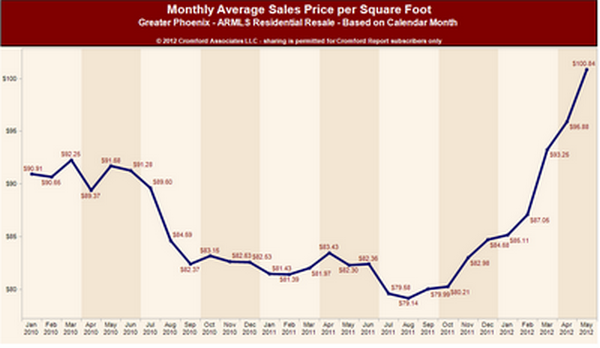
Remember that housing is a local issue, not a national issue. So any discussion of our marketplace by necessity must be confined to our marketplace. So let’s look at what is a fact, the price per square foot is up by an average 24% since September. That is a fact. What does that mean for the home seller or buyer in this market?
First to the seller: the message here is that the market has improved greatly and for those sidelined from selling due to value issues, it may be time to check current pricing in your neighborhood. Does that mean every home has gone up 24%? No. As could be predicted, price point has something to do with the movement in values. The lower prices (let’s say $500,000 and under) show the really significant price appreciation. Above 500K we see a different picture with price per square foot showing both less of a drop and less upward movement as well.
Also, another factor that is slanting the numbers a bit is the dropped numbers of homes coming to market. This is one of the factors contributing to the price rise – reduced supply. In our opinion this is the untold story of the market. New listings coming on the market continue to hit record lows since 2011(when that statistic first began being kept). The dropped supply is actually affecting the number of sales – Phoenix single family homes are down 18% compared to 2011 the same time of year. Mesa sales are down 10% and Glendale is down 15%. However, Scottsdale is up 5% over last year. Because Scottsdale homes are more expensive on a per square foot basis, this is affecting the monthly average appreciation just by virtue of throwing higher priced homes in to the mix! So although appreciation is on average 24% since September, that number may be a little bit higher than “reality†given the drop in lower priced sales and the increase in the higher priced sales.
To state the obvious, the best way to determine your current market value for your home is to request a Market Analysis from a competent agent (I highly recommend us). Even then with supply and demand in flux and pricing shifting, the value is a moving target these days. A “range of value†for your home is probably the best you will do on determining pricing without actually placing your home on the market.
To buyers: prices today are likely lower than tomorrow’s values. If you are a buyer, be prepared for the frustration that goes with rising values, limited supply and a strong seller market. Currently, most homes are receiving multiple offers and cash offers are abundant and often winning over financed offers. Asking prices in the lower price ranges in particular, are just starting points for the offers as most offers will be above list price. Those who say “I don’t want to play a bidding gameâ€Â need to understand that avoidance of this market and the competition for homes means that you are willing to pay more down the road for the benefit of being the sole bidder.
Rising prices at some point will dampen demand – the real question is how high and how long until we hit that point. That is the million dollar question. As the future market unfolds we will attempt to answer it for you. As always, we are here to help you with the challenges this market presents.
Russell & Wendy Shaw
(Mostly Wendy)
Debunking Phoenix Real Estate Myths
Residential real estate has always been more of an emotional business than fact based one – probably due to the fact that buying and selling a home ranks high on the stress list. So the battle in a recovery is one of the mind more than the realities of the market place. Reality shifts first and eventually the mind follows. Here are a few of the fallacies we hear from both sellers and buyers and even more surprisingly agents (gasp!).
Myth number one: The banks have a large “shadow†inventory they are waiting to release
This is probably the number one falsehood that is bandied about at dinner parties and even by the media. We have been hearing this rumor for years now and each year it proves to be unfounded. What causes such a persistent rumor? Our guess is twofold – one, conspiracy theories always rise over fear. When something seems out of control or unpredictable it seems that human nature forces an invention of “facts†when the facts seem unconfrontable or unknowable. Secondarily, the argument for shadow inventory arises due to the “reported†foreclosure numbers vs. the foreclosures that can be traced through resale methods. Because the “reported†numbers are so much higher than the foreclosures that can be traced, it prompts the belief that the banks are strategically holding back a “shadow inventoryâ€. The fact of the matter is that reporting methods for foreclosures are routinely filled with errors.  Here are just some of the errors that lead to the erroneous belief that a shadow inventory exists. Some properties have multiple lots with only one home, but are reported as if each parcel was a foreclosed home. Some reporting sources count the notice of default as well as the actual foreclosure – which alone doubles the number of “foreclosuresâ€. Even worse are the sources that count each notice of default as a “foreclosure†– which is ludicrous considering that ten notices to the same house (and believe me delinquent homeowners usually receive at least 7 certified notices of default) does not equate to ten foreclosures. One delinquent homeowner is still one foreclosure – even if ten notices were sent! Also, notices of default are sent to homeowners who are mid-modification or mid- short sale. These are often resolved without foreclosure – but are counted as a “hidden foreclosureâ€. The examples of errors are numerous – the point being this is often behind the reporting of hidden inventory. Recently a Wells Fargo local representative confirmed publicly that Wells “has no shadow inventoryâ€.
Myth number two: Prices are still dropping This is not only untrue, the opposite is true – overall the Valley home prices are rising and rapidly. Yes it is going to take time to dig out of the hole from the crash of 2007-2011, but the recovery is underway. The luxury market and the 55+ communities did not see the same level of drop in pricing and therefore are not experiencing the same leap in pricing as we are seeing in the lower price ranges. But as inventory levels are lower than demand, pricing is moving upward. We expect this trend to continue through the year at least.
Interest rates will stay low forever because the government will make it that way
Yes, there are people who believe this even though there is no basis in fact for this idea at all. In the first place, long term rates (10 year bonds and mortgages) are not “set by the government†in any way, shape or form. The government can’t control these long term rates (up or down) even when they have tried to do just that. The government (via The Federal Reserve Bank) sets short term rates. Overnight rates – the rates that bank charge each other. Not long term rates at all. The “rental rate†for money (current interest being charged) is set by the market – supply and demand. Money is a commodity. How much it will rent for is based on how much is available and how great the demand is at that time. Long term rates are “regulatedâ€, if you will, by what investors believe is going to happen with future inflation. So what does this mean to the homeowner? Our belief is that the currently low interest rates will not last indefinitely. This is a signal to buyers and the move-up seller to pull the trigger on any purchase sooner rather than later. Interest rates will impact the monthly payment for a home far more than minor pricing fluctuations.
Arizona is one of the top 10 states for delinquent loans
A couple years ago this would have been true as Arizona was number four out of all the states for delinquency. Now Arizona ranks at number 33 – and our delinquent loans are now at only 6.6% (compare that to over 12% in February of 2010 when we were number 4 in the country). In fact, our delinquency ranking is the most improved in the last 2 years, another signal that recovery is underway.
So again, we stress that our market is in recovery. For sellers this is good news; the home that once may have felt like an anchor dragging down homeowners, may be on the road to becoming an asset again. If you have been waiting to sell, feel free to contact us to see if current pricing allows that to become an option for you once again.
Thank you as always to Michael Orr of the Cromford Report and our loyal friends and clients. We are better for you in our lives!