Supply – a “Tale of Two Cities”

Supply continues to be the story in the valley (or lack thereof).  But it really is a tale of two cities – if the cities were price points – the 200K range vs. all other price ranges.  Single family homes under 200K seem to be the wooly mammoth quickly headed for extinction.  Understandably entry level buyers and their agents are bemoaning the lack of inventory in that coveted price range.  Perhaps there is a need for a bit of a reality check. Phoenix is the 5th largest city in the US. The rankings currently are:

  1. New York
  2. Los Angeles
  3. Chicago
  4. Houston
  5. Phoenix

Phoenix has enjoyed a reputation of “affordable housing” due to its large land mass.  Whenever more houses were needed, builders had plenty of land to build them.  A steady source of new supply kept pricing low.  This brought about the “drive until you qualify” phenomena as the valley expanded ever outwards. Builders are happy to build but land, labor and material costs make them unable to bring single family housing to the market in the price range most needed. When we look at the valley in the context of cities such as New York or Los Angeles – do most buyers in those cities expect single family housing to be available at 200K?  No.  So it may be that we simply are struggling to come to grips with our big city status.

In any case, let’s take a look at where we stand in the early stages of 2018.  The year began with 14% fewer homes for sale than in 2017.  We are currently seeing a slight improvement over 2017 for the number of homes entering the marketplace (up 1.4%) – but it is early and the improvement is very small.  To quote Michael Orr of the Cromford Report:

“So the good news for buyers is that we do have slightly more homes coming onto the market. The bad news is that this is not enough to ease the supply shortage. In fact it is not even enough to compensate for the higher sales rate in 2018 over 2017. Closings are so far up 3.2% year over year so a 1.4% increase is less than half what is required to replace homes sold.

Looking specifically at Greater Phoenix we have 6,859 listings with a list date of Jan 1 through Jan 21, 2018. Compared with last year we have seen

  • 26% fewer new listings under $200,000
  • 5% more new listings between $200,000 and $300,000
  • 5% more new listings between $300,000 and $400,000
  • 12% more new listings between $400,000 and $500,000
  • 21% more new listings between $500,000 and $1 million
  • 5% more new listings between $1 million and $1.5 million
  • 36% more new listings over $1.5 million

So perversely, but not unexpectedly, we are getting the largest percentage increases at the high end of the market where more supply is not really needed. Below $200,000, where supply is already extremely thin, the new listing flow has dropped even further from last year’s rate….

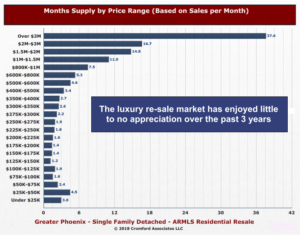
However the 2% of the market over $1 million benefits from having 12% of the active listings – six times its fair share. Consequently buyers have a much easier time if they are planning to spend $1 million or more and sellers are rarely in control of the negotiations. This is why you see some spectacular price cuts in the high-end market and a sales pricing trend that is flat to slightly lower. We should emphasize that this applies to the re-sale market and not the new home market…”

If you are a seller – the price point you are in will affect your “home selling experience.  Typically, the lower the seller is on the pricing scale – the higher the odds of multiple buyers competing for your home.  When demand is out of balance with supply, in favor of sellers, multiple offers occur and there is upward pressure on pricing.

This would all appear to be good news for sellers, right?  Well yes, but a strong seller market can hide mistakes that cost sellers thousands of hard earned equity.  For example, sellers can decide to “go it alone” by either selling the home to a friend or neighbor or to a “we buy houses company”.  To many that looks like success – one buyer and the home is sold without placing it on the market.  To us in the business, that looks like a disaster. How can you know for certain what a “competitive” offer is without competition? Any home has a range of value.  What pushes homes to the top end of that range?  Competition.  Capitalism is based on that very concept.  Competition (thru marketing) is how we as agents create bidding wars for the home.

Sadly it isn’t enough to create the competition, once created one must know how to handle it.  How an agent handles multiple offers separates the men from the boys.  This again is where thousands can be made or lost.  Make sure that whomever you hire knows how to get the highest and best out of each offer and to successfully exploit that competition.

It is important to note that supply and demand imbalances will correct with time. In fact, we are already seeing lowered demand than last year. The cycle basically goes like this: tight supply increases pricing; increasing prices dampen demand; lowered demand creates more supply; more supply lowers prices.  So the pendulum of supply and demand (and thereby pricing) self corrects with time.  When will that correction begin and supply begin building?  We don’t know but we will be watching for it and will keep you alerted to any shifts. Wondering about something we didn’t address here?  Contact us.  As always, we are happy to answer your specific concerns.

Russell & Wendy Shaw

(Mostly Wendy)

Kimmie is a tabico!

She is an eighteen month old calico tabby, she is a brown tabby with orange sprinkles.  Kimmie is outgoing and social, doing her best to get everyone to play.  If you don’t play with Kimmie, she will entertain herself while putting on a show for you.  Kimmie also does her best to make friends with the other cats and kittens at the shelter.  Come down to Home Fur Good at 10220 N. 32nd Street in Phoenix.  The Free Roaming Cat Room is open for adoptions Thursday, Friday and Saturday from 11am – 4pm.  You can also call at 602-971-1334.

Welcome to 2018

We hope you all had a wonderful holiday season!  Now that we are off to a fresh new year it makes sense to note where the market currently stands.

Supply

Undoubtedly our serial readers are already well aware that the 500K and under range has been in a “sellers” market for all of 2017.  What most may not know is that inventory usually sees a build up in the fall as demand tapers off.  Fall 2017 saw a very minimal increase in inventory and in the under 200k single family supply is so paltry as to seemingly be headed for extinction. Entering 2018, active Listings are down 12% from this time last year.   There appears to be no relief on the horizon.  As our favorite real estate market watcher the Cromford Report states:

It is easy to get complacent about the low inventory and assume that this is somehow the “new normal”. The long term decline in active listings just keeps going and we have now reached the point where days of inventory is the lowest we have seen for week 50 since 2004 (at the height of the bubble). …To try to get a handle on what life is like in the regular market, let us focus on homes priced at under $500,000 in Greater Phoenix. The inventory for this segment is 52 days. If we use $250,000 as the price limit we have just under 40 days of inventory. These are not normal readings and we start to wonder how low can these numbers go.”

This means buyers are going to have an even tougher time buying than last year in any price range other than luxury.  For most sellers, they should enjoy competition from buyers and stronger pricing.

Demand

Demand has remained relatively stable and unremarkable especially compared to its counterpart supply.  Demand was on a weakening trend in the 3rd quarter but that seemed to shift upwards mid-November and certainly provided a busier than normal December.  An interesting side note is that buyers are now primarily in-state buyers (i.e. local house changers) .  The Cromford Report notes :

 “… migration into Arizona is weaker than it was during the 2000-2007 era. In 2004 we saw 30,564 purchases by out of state buyers. 2017 year to date is 16,443 …The total sales count is lower and the percentage of sales going to out of state buyers has dropped from 20% to 16%…The flip side of this is that in-state demand has increased from 80% to 84%. Areas that appeal most to in-state buyers have seen stronger appreciation.”

Appreciation

Supply and demand ultimately dictate appreciation.  It should come as no surprise that appreciation was greatest in the lower price ranges due to low supply.  Turning back to the Cromford Report we can see exactly how true this is:

”After peaking on July 28 at 8.6% the appreciation rate for all areas & types went into a declining trend until November 9 when it bottomed out at 3.6%. It then changed course and over the last 5 weeks has risen sharply to reach between 7% and 7.5%…. Such a rapid change in direction is quite unusual.

The overall appreciation rate based on annual sale price per square foot in Greater Phoenix is 6.2%.  However, supply and demand are not the same by price range. The greatest appreciation rates are under $200K due to a lack of new construction that would typically balance out the supply shortage.  Sales under $200K are 33% of all sales this year, so their rate has a large effect on the overall average.  New multi-family and single-family homes are being added to the $200K-$500K price range to accommodate increased demand, but it’s still not quite enough.  The market is balanced between $500K-$1M, while supply is still higher than demand over $1M despite a 10% rise in 4th quarter contracts.  As a result, appreciation rates are as follows by price range:

  • Under $200K:  7.7%
  • $200K-$500K: 3.5%
  • $500K-$1M: 1.7%
  • Over $1M: 0.1%”

Agents

We rarely talk about real estate agents – although they certainly can impact the marketplace in subtle ways.  It may be of interest that there was a 6.6% increase in the number of real estate agents since last year as rookies continue to enter the field. While agents certainly don’t set the marketplace (supply and demand does) they certainly can influence the buying and selling experience. Agent skill impacts the counsel clients receive on market behavior or not; negotiate the highest market value or not.  They should be the client’s biggest advocate and legally in fact have a fiduciary relationship to the client.  As the institutional investment companies are swarming the valley (Offer Pad, Open Door, etc.) sellers can learn the hard way the impact that a missing real estate advocate has in terms of reduced proceeds.  Particularly disturbing is the institutional buyers’ offers of “no commission sale” while charging fees in excess of 9% – far beyond what might be charged as a commission.  Add in the typically lower than market value and imaginary “repair costs” and sellers are paying dearly for that lack of representation.  Lower than true market value sales can impact appraisals and subsequent neighboring sales – a sobering thought for all of us vested in defending neighborhood values.

As 2018 continues to progress we will endeavor to keep you apprised of the emerging trends.  Of course every home sale has its own concerns, so please don’t hesitate to contact us for a customized analysis of your neighborhood.  Here’s to a wonderful 2018!

Russell & Wendy Shaw

(Mostly Wendy)

Kettle is a very people-oriented doggie.

He thrives when taken out for social interactions and activities.  The calendar says that Kettle is seven years old, but no one has told him that.  He is energetic and loves to be active and on the move.  Fetch is his game and his feet start to dance when he sees the leash.  He is a 35 pound Staffordshire terrier mix, perfect to fit on a lap for snuggle time or to take out on an adventure.  Home Fur Good is located at 10220 N. 32nd Street in Phoenix.  The shelter is open Thursday, Friday and Saturday from 11-4.  You can call Home Fur Good at 602-971-1334.

2017 Draws to a Close

Is it just us, or has 2017 seemed to fly by?  As 2017 heads to a close, inevitably we reflect and compare this year to the previous year.  Although the final tallies are not in, we still can draw some solid comparisons.

PRICING

Most homeowners and would-be homeowners (buyers) find pricing statistics the most interesting of all statistics, understandably.  Yet it is wise to remember that pricing is a trailing indicator – not a leading one.  Pricing trends take time to show up and become meaningful. Further there is a seasonal factor that can obfuscate the market trends.  For instance, in a “typical” year pricing rises during the spring buying season and tends to peak in June.  Then the second half of the year goes flat on pricing (and can even have a small retreat).  Pundits who don’t know or care to factor in the seasonal component of the market can write alarming headlines about the market when fall arrives – only to see it miraculously “recover” again in the spring.  Annual prices tell the actual story of what occurred.

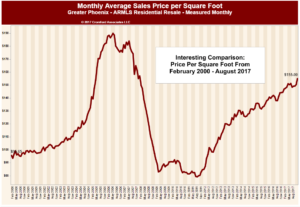
At the moment the overall market appreciation stands at 5.8% – but understand that this includes all price points and areas and is simply a market average.  Separating pricing into categories tells a far more accurate story.  Appreciation under 200K remains strong as demand is outpacing supply.  Luxury sellers are having a very different experience – even with supply currently lower than 2016.  Some luxury price points have seen a small erosion in pricing.  To quote our favorite real estate source, the Cromford Report:

Price trends remain weakest for the high end of the market and despite much stronger sales numbers than last year, the top end remains over-supplied. This is not unique to Central Arizona as we see similar weakness in luxury pricing across most of the USA. The low-end and mid-range still have price momentum and given the deterioration in supply, especially in the Southeast Valley, we expect that to continue for some time.

Interestingly, condos & townhomes are enjoying a faster appreciation rate than single family homes at the moment. This is largely due to the price point and the demand they are able to answer that single family homes simply cannot fill.

Because supply/demand ratios ultimately tell the story of the market and are a leading indicator, let’s turn our focus there.

SUPPLY

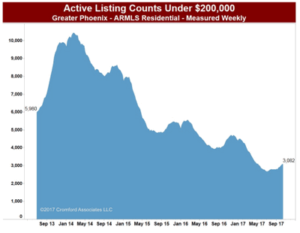
Given that appreciation has been strongest in the under 500K range – especially under 200K – it should come as no surprise that supply is most constricted under 200K.  What started as a promising year of a crop of new listings, fizzled in to only a small advantage over 2016.  As prices have risen, the low end of single family homes is evaporating as homes previously valued at less than 200K now rise above that mark.  New supply, which usually is typically supplied by builders, is simply not coming.  Builders cannot provide single family product at that price point due to land costs, labor costs, and the cost of the commodities needed to build a home (concrete, wood, roofing materials, etc.).  Not surprisingly multi-family building has risen to provide needed apartment rentals for those who cannot afford to buy entry level housing.  Again the Cromford Report summarizes the situation:

So far in 2017 we are up only 1.15% for new listings over this time in 2016. Overall, the supply remains chronically weak and there is little sign of any improvement… Here we can see the huge reduction in supply that has occurred over the past 4 years. The seasonal pattern clearly shows up, but each year is much lower than the year before. It is starting to look as though there will not be much of a market below $200,000 before too long.

DEMAND

Demand can be far more volatile than supply and more difficult to gage.  Improving economic factors (jobs, interest rates, income, stock market, etc) or a decline in those factors can influence the housing market along with supply.  The stock market showing sharp improvements can impact the luxury market to the positive, where it has little impact on the entry level market.  Rising prices are supposed to have a dampening effect on demand – so that supply and demand in counter-reacting to each other create a balance. This is not always a tidy process, however, as we’ve seen through the last 10 years.  So what do the tea leaves say currently about demand?  We again turn to the Cromford Report:

and demand has been slightly weakening for several months now and at first sight it looks slightly weaker again at the start of October, although when supply is poor, it can be very hard to detect weakening demand out there in the market because there is enough demand to soak up all the supply and then some.

SALES

Supply and demand intersecting ultimately results in sales.  The Cromford Report supplies a lovely snapshot of the sales:

 The first half of 2017 was more exciting than the second half is turning out to be so far for MLS sales. 1st Quarter 2017 MLS sales outperformed 2016 by 14% and 2nd Quarter sales were up 7%, so a 2% growth rate for the 3rd Quarter puts a damper on our excitement. Low supply in the lower price ranges is mostly to blame as it’s difficult to have record sales growth if there are fewer people willing to sell their home. There are more people willing to put their home on the market in the higher price ranges however. New listings over $600K were up nearly 10% in the 3rd Quarter and sales were up an impressive 27%.

We hope this gives you an accurate picture of the market so you can ignore any headlines to the contrary.

As the holidays approach, we want to take a moment to thank all our clients and friends whom we are so fortunate to work with.  We are truly humbled by the trust you place in us and we are committed to always doing our best to protect your interests.  Thank you and Happy Holidays!

Russell & Wendy

(Mostly Wendy)

Ginger is the queen with a perfect amount of Cattitude

If you would like the privilege of living with a cat that knows they are the superior being, then Ginger is your girl.  Ginger was born on January 21, 2014 and she will allow you to feed her, play with her and scratch her under the chin until she decides otherwise.  Ginger can be very loving and playful and then she will decide she needs alone time.  Ginger does ask that she be the only cat in her forever home, since there can only be one ruler.  You can meet Ginger at Home Fur Good, 10220 N 32nd Street, Phoenix, Thursday through Saturday from 11am-4pm.  If you have any questions please call 602-971-1334.