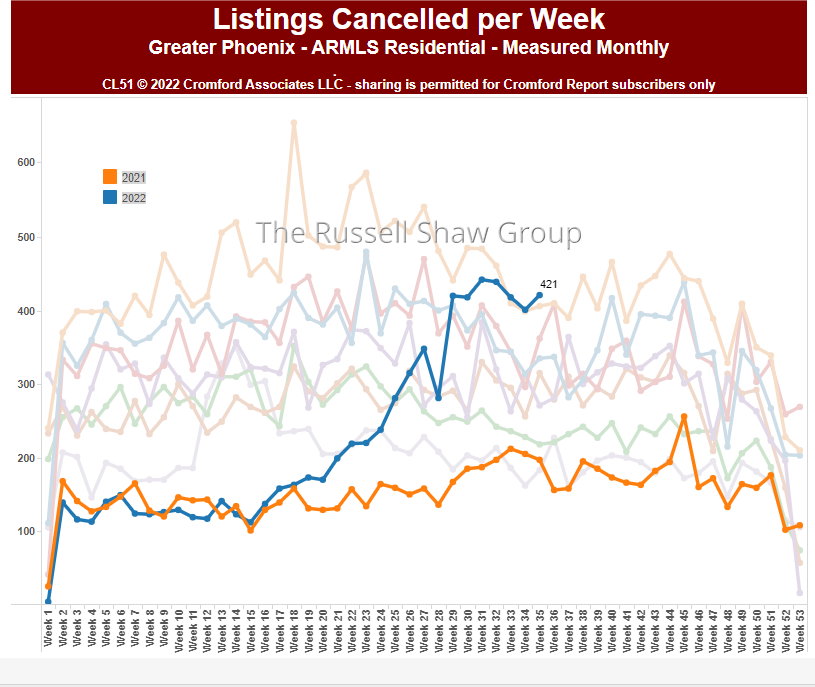
Enough time has lapsed that it seems fairly certain the peak of the market was reached in March. Since then, one market indicator after another have been tipping – confirming a rather dramatic market shift is underway. The number of properties for sale is up (more than double since March), pending sales are dropping, closed sales are dropping, and the percentage of homes failing to sell is increasing. It all sounds pretty dire but despite that, we are still in a seller’s market. For the moment.
For Buyers:
In the last 10 weeks, Buyers in the above 400K range have seen a steadily increasing supply of homes. Tina Tamboer of the Cromford Report shares this:
“In a nutshell, when sellers have to compete, buyers win. What they win at this stage is their sanity and some normalcy in the home buying process. By normalcy, typical contract requirements such as appraisal and inspection contingencies remain in place. There may be multiple properties available that fit a buyer’s needs, instead of only one with multiple offers already submitted. The median number of days prior to contract is now 11, up 4 days from last month, which provides more breathing room for scheduling showings.”
For Sellers:
Sellers are now going to have to manage their expectations – which is difficult after years of holding all the cards. As competing supply continues to rise sharply, sellers should be prepared for more extensive marketing periods, less showings, more flexibility in negotiations, and even correcting unrealistic pricing (i.e. price reductions). At the current rate of change we could be in a balanced market as soon as August. In a balanced market, a third of the properties for sale will not sell with their first agent. Not surprising given that most agents are ill prepared – having never been in a balanced market – much less a buyer’s market. Although sellers still retain a gentle advantage over buyers, only extreme markets hide mistakes. The agent’s ability to counsel, advise, and negotiate are getting very important again. Our best advice? Choose wisely.
The Exception:
The under 400K market is not seeing new listings surge like the other price points. But it is more sensitive to interest rate fluctuations and pricing than higher price points – which is causing demand to drop. So far the impact in that price range has been minimal and it currently remains stronger than the other segments of the market.
Wonder about your specific neighborhood? Contact us for a free supply/demand evaluation. After over 40 years, we have seen every market.
If you’re ready to buy your first house, it may be difficult to choose between a starter home or your forever home. Here are some ideas to think about when you’re reviewing your options.
Buying and Insuring a Property
When you buy a home, you also need insurance. Homeowners insurance only covers the structure of the property, injuries, or belongings in a burglary. A home warranty is another option that covers your home systems and appliances. Home warranties are renewable annual plans that help cover the costs of appliance repairs and major systems breakdowns, such as HVAC, plumbing, and electrical. To choose the best one for your needs, home warranty reviews are a good place to start.
Starter Home Pros and Cons
Buying a starter home is one way you can be a homeowner. A starter home is a property you plan on selling at some point in the future when you’re ready to upgrade. Here are factors to consider with a starter home.
Affordable
Housing prices continue to rise, with the median U.S. home price at $375,000, according to the U.S. Department of Housing and Urban Development. Starter homes are usually lower than the national average.
Less Upkeep
Your starter home may also not require as much upkeep, especially if you plan to move within five years. A smaller home also costs less for repairs and other maintenance items.
Potential for Producing Income
Starter homes can also be used as rentals when you decide to move. Consider keeping a starter home and renting it out to get a second income.
Smaller Space
The cost savings may also come with a smaller living space. In most states, home sizes are getting bigger, so a starter home may feel cramped.
More Outdated
Starter homes are usually older and less modern. If you purchase a cheaper starter home, you may have outdated appliances and older decor that hasn’t been updated.
Neighborhood Issues
The first home you buy may also not be in the best neighborhood. If your home is in a bad neighborhood, there could be more property crime and safety issues.
Forever Home Pros and Cons
First-time buyers also can decide to immediately buy their forever home. This approach also has some financial and lifestyle pros and cons.
Setting up Roots
The biggest pro to moving right into your forever home is to set up your roots. This can help you avoid moving again and keep you in a great neighborhood.
Potential to Grow Your Family
Buying your forever home as your first property also gives you the flexibility to start growing your family whenever you want. Couples that plan to have children can have enough space and bedrooms to expand.
Able To Invest in Unique Decor
Another pro is that you can buy big-ticket items, heirloom furniture pieces, and unique decor without having to worry about moving them later. You can also add a pool, hot tub, fence, garden, and custom landscaping.
More Expensive
The top con of buying your forever home first is the cost. A larger home may give you some sticker shock. There is also the higher cost of utilities and property taxes to consider.
Lots of Upkeep
Finally, you also may need to invest more time and money into maintaining your forever home. Maintenance and repairs may be pricier than a typical starter home and may require some sweat equity.
Investing in a starter home or purchasing your dream forever home is a big step in life. Whichever path you choose, you can be a homeowner and start living your dream. Have the Russell Shaw Group on your side. Reach out today.
We have been sounding the alarm bells for months that the market was shifting – even if no one was feeling the impact. In the last few weeks, the numbers are confirming a dramatic shift. Here are the facts – rather than clickbait headlines.
The alarming news
Overall the supply of active properties is up 40% from this time last year. More shockingly, the supply of MLS properties for sale is up 45% in 6 Weeks. Pretty dramatic, right? The Cromford Report shares these numbers: “Inventory listed between $400K-$500K is up 35% in just 3 weeks. Counts in all segments between $500K-$1M are up 99% in 6 weeks and the count from $1M-$1.5M is up 54%, also within 6 weeks.” If you are a seller or would-be seller, this is important information confirming a radical shift is under way. Jumping numbers of available properties are not good news for sellers. But please, read on.
What is happening?
Not surprisingly, the rising prices along with the rising interest rates are doing what they are supposed to – dampen demand. Interest rates rise quickly and lower slowly. Thereby affordability is taking a big hit that is not going away soon. For those shocked by interest rates in the 5% range (having become acclimated to rates in the 3% range) we gently remind you that historically rates have averaged in the 8% range. But back to supply, it is not that a flood of listings are coming to market but rather less are going under contract. That is what dampened demand looks like – less things selling. When less things sell, supply builds.
What this means and why not to panic
Not all price points are experiencing rising inventory in our market. The properties below 400K are still scarce and in high demand. Additionally, the overall number of available properties remains ridiculously low. The Cromford Report confirms: “As of this report, the supply count is 7,157, still 72% below normal for this time of year but rising quickly”. We repeat, 72% below normal.
What does this all mean? If you are a buyer shopping in the 500K+ market – you will have more choices and less competition. If you are a seller, your prices are not dropping and you still have below normal competition. The Cromford Report summarizes:
“The market is in the early stage of shifting out of an insane seller market and into a mere frenzy seller market. Before we know it, it could be a regular old hot seller market where properties still appreciate but take multiple weeks to sell…While the market is still strongly in favor of sellers, it is changing rapidly. For those sellers waiting to sell close to the peak of price, this may be the time to list. Prices are still projected to continue rising, but at a slower pace over the next few months.”
We hope this helps put in to perspective the shift. Caution is advisable, fear is not. If you have questions about buying or selling in today’s market, contact us. Market knowledge is our business.
“The bad news is nothing lasts forever. The good news is nothing lasts forever.”
― J. Cole
In our last article, we speculated that the market may have peaked. More and more signals of a shifting market seem to reaffirm our suspicions. But, as we try to remind both buyers and sellers, the real estate is not the stock market. Housing moves slowly. Shifts in demand are quicker than shifts in housing supply. So while the scarcity in supply has been the controlling factor in the housing market for a number of years, demand is now the impedance behind this subtle shift.
Demand is dropping
What is driving this drop in demand? Not surprisingly – reduced affordability. The combination of rising prices and rising interest rates are doing exactly what they are supposed to do, reduce demand. At least in the case of the owner occupied buyer. However, supply and demand are still strongly unbalanced in favor of sellers. This makes the change imperceptible to most. From the Buyers perspective, selection is sparse and prices steep. On the Seller’s side, they have gone from receiving the once typical 20+ offers in the first 2 days, to now typically only 3-4 in the first week. But sellers are still selling at above asking prices to exhausted buyers.
Tina Tamboer of the Cromford Report confirms what we are seeing:
The market continues to heavily favor sellers. Supply is still 76% below normal for this time of year and demand is 6% above normal. However, demand is declining in response to recent increases in interest rates. Just 30 days ago, demand was 12% above normal, and 30 days prior to that it was 21% above normal… However, in just a few short months, the average interest rate increased from 3.1% in December to 4.7% by April. This resulted in a $500 increase in the estimated payment on a 1,500-2,000 sq. ft. home, pushing the cost to buy significantly higher than the cost to rent in Greater Phoenix.
This does not mean the market is at its peak, or at the precipice of a price decline. The only response we are seeing at this time is a sharp increase in supply between $500K-$1M over the past 2 weeks, a price range that happens to have less interest from investors and 2nd home owners and a higher market share of owner-occupants.
Rental rates are dropping
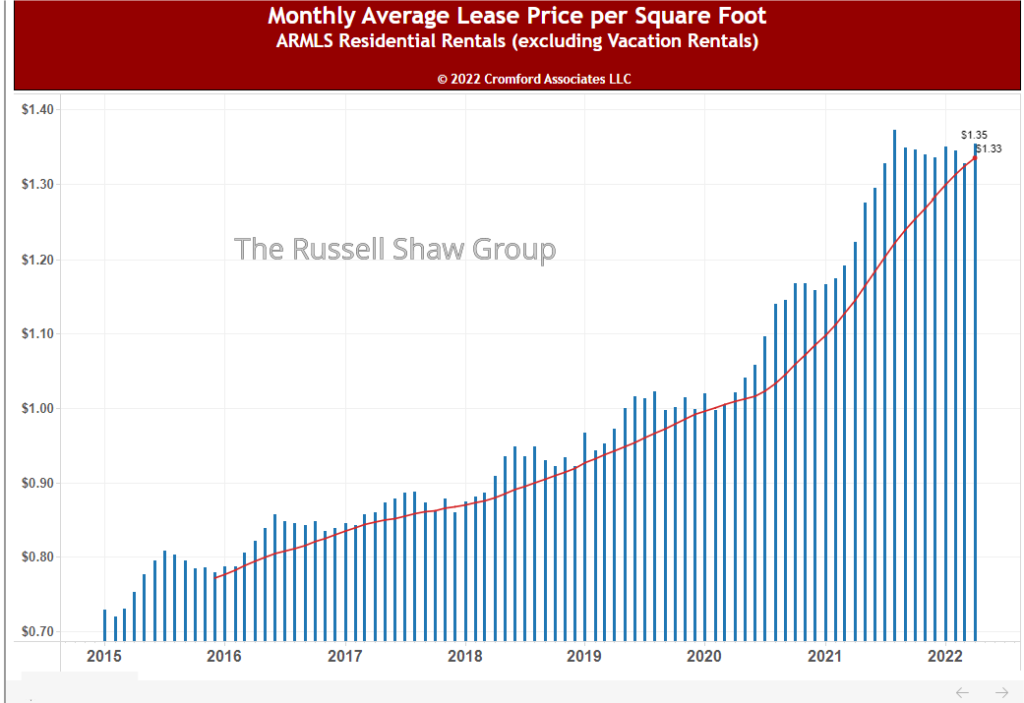
Most people think that the rental market and the resale market are two very distinct markets with little connection. Not exactly. Any increase in net migration to the valley must be met with the near equivalent in housing –either in the form of ownership or rental. When rentals become more plentiful than tenants, rental rates decline. When rental rates decline below the cost of a house payment, first time home buyers rent rather than buy. This further reduces demand for resale homes and interrupts the chain of buying (i.e. the first time homebuyer does not buy the entry home which allows that seller to buy their next home, and so on up the chain about 7homes deep). Losing thefirst time home buyer to the rental market has a serious impact on the resale market. Further, when rental rates decline, investors with a rent and hold business model leave the home purchasing market for better returns on their dollar– further weakening demand. As the Cromford Report confirms:
“Over the past 4 weeks we have seen a 34% increase in the number of new rental listings added to ARMLS compared with the same 4 weeks in 2021. There has also been a 20% increase in the number of rental homes available in Phoenix on the Progress Residential web site over the past 4 weeks.
Renters of single-family detached homes are seeing far more choice than they did last year and we are starting to see homes advertised with “the first month’s rent is free”. Rental supply is particularly strong in Gilbert.
This appears to be a significant turnaround in the rental market and it does not seem to have been recognized by the media outlets, who are mostly still referring to rising rents. That is so 2021.”
Supply is slowly rising
When demand drops, it allows for supply to increase. As of the writing of this article, the active properties for sale on MLS sits at a meager 5,487. To achieve a normal level of supply, we still need about 20,000 more properties for sale than are currently on the market. As we mentioned, increases in supply take time. How quickly that supply builds will determine the alacrity with which the market rebalances.
Pricing
Does this mean prices are posed to plunge? In the short term, no. Price is a trailing indicator in housing, not a leading indicator. In order for prices to level out or drop, supply needs to exceed demand. Pricing can trail a shift in the market by as much as a year or more. Therefore, we expect pricing to continue to rise this year. As the Cromford Report points out: “While it’s reasonable to expect price appreciation to slow down at some point, there is little evidence at this stage to show prices declining in the near future.”
Selling your home
This market has allowed for all methods of selling to appear successful – as a strong market can cover up mistakes. As this market shifts, it will be increasingly important that sellers hire the right agent to sell their home. Whether seeking a no commission cash offer or professional marketing program to maximize your net – the right agent can give you all the choices that protect your selling power. We certainly know that we can.
Have more questions or are curious about your home and when is the best time to sell? Contact us we are always here to help.
Deciding what to do with your Phoenix home once it’s time to downsize is tricky. You have three main options – keeping it, renting it out, and selling – and each one comes with pros and cons.
While it seems straightforward, downsizing usually comes with a slew of other decisions. For example, if you now require 24/7 medical care and can no longer live safely in your current house, you’ll need to figure out where to move to might feel overwhelming. While you can look online for detailed facility reports, pricing info, payment options, and reviews from other families for nursing homes in Phoenix, it’s a lot to handle.
Seizing opportunities to make any decision easier is essential. That way, you can choose a path quickly, allowing you to move forward. If you’re debating between keeping, renting, or selling your current home in Phoenix as you prepare to downsize, here are points to consider.
What to Do With Your Home: Keep vs. Rent vs. Sell
The Pros and Cons of Keeping the Home
Usually, the main benefit of keeping the home is the ability to pass it down to a family member. That’s especially true if the house is paid off (or nearly so) and in good repair. In that case, it can provide a family member with a substantial amount of value without many of the financial hassles that come with the ownership transfer. However, it’s still possible to inherit property with a mortgage, so keep that in mind.
When it comes to drawbacks, ongoing costs and maintenance are a big part of the equation. Even if the house is paid off, you’ll have to deal with property taxes and insurance. Plus, maintaining the structure and systems is essential to keep the house in good shape, which isn’t always cheap.
If you’re on a tight budget and can’t transfer ownership immediately, then merely keeping the house might not be a great option. But if that doesn’t apply and you want to pass it down, it’s worth considering.
The Pros and Cons of Renting the Home
Renting the home can be the right choice if you want to generate long-term income and are open to navigating ongoing expenses. While you’ll still owe property taxes and have to cover maintenance costs, you’ll typically get a set sum from your tenant each month the house is occupied.
As for the drawbacks, operating as a landlord can be a lot of work. Landlords have specific obligations, and they can be a lot to manage. While you can choose to hire a property manager instead, you’ll have to direct some of your rental income to cover that cost. Depending on what the property manager charges, that could significantly limit your earning potential.
There can also be some tax complexities you’ll need to navigate. Additionally, if the property is occupied when you pass, it can lead to difficulties for the heir.
The Pros and Cons of Selling the Home
Generally speaking, selling your home has a few drawbacks. The main one is that you can’t pass that property down to an heir.
Otherwise, most of what you’ll experience is benefits. The Phoenix housing market is hot, with prices rising 31.3 percent year-over-year (as of February 2022). Plus, the demand for housing is expected to remain high throughout 2022. While mortgage rates are rising, concern that they’ll keep going up could keep buyers in the market.
By selling, you also eliminate any ongoing responsibilities relating to the property. After the sale, maintenance, property taxes, and insurance for the home are no longer your responsibility. You can also use the proceeds as a nest egg, giving you extra cash to fund your golden years.
Ultimately, selling is the right choice for many seniors. If it’s the right move for you, contact Russell Shaw to learn more about what your home is worth and how you can get it on the market.
The early warning signs of a shifting market continue to appear. But, as we try to remind both buyers and sellers, the real estate is not the stock market. Housing moves slowly. Shifts in demand are quicker than shifts in housing supply. So while the scarcity in supply has been the controlling factor in the housing market for a number of years, demand is the impedance behind the shift. Not surprisingly this drop in demand is being driven by affordability. The combination of rising pricing and rising interest rates is doing exactly what it is supposed to do, reduce demand. With rentals becoming more plentiful and rental rates declining, and investors with a rent and hold business model will at some point also begin to leave the market – weakening demand further. Does this mean prices are posed to plunge? In the short term, no. Here are some supporting comments from Tina Tamboer of the Cromford Report.
The market continues to heavily favor sellers. Supply is still 76% below normal for this time of year and demand is 6% above normal. However, demand is declining in response to recent increases in interest rates. Just 30 days ago, demand was 12% above normal, and 30 days prior to that it was 21% above normal… However, in just a few short months, the average interest rate increased from 3.1% in December to 4.7% by April. This resulted in a $500 increase in the estimated payment on a 1,500-2,000 sq. ft. home, pushing the cost to buy significantly higher than the cost to rent in Greater Phoenix.
This does not mean the market is at its peak, or at the precipice of a price decline. The only response we are seeing at this time is a sharp increase in supply between $500K-$1M over the past 2 weeks, a price range that happens to have less interest from investors and 2nd home owners and a higher market share of owner-occupants…While it’s reasonable to expect price appreciation to slow down at some point, there is little evidence at this stage to show prices declining in the near future.
Call us for advice on your particular home sale or purchase. We are here to inform.
Most sellers are not aware that the rental market and the resale market are intertwined. When demand for rentals are high, rental rates rise. When it is more expensive to lease than to buy, first time homeowners buy. That spawns a chain of buying – allowing the seller of that first time home buyer to buy their next home, and that seller to buy, and so on. When rentals start to stagnate, prices drop for rentals making it more attractive to lease. When it is cheaper to lease than buy, would-be home buyers exit from the resale market.
Tina Tamboer of the Cromford Report shares this information on the rental market: “However, be aware that the estimated payment for a 1,500-2,000 square foot home is now $77 higher than the median rent for a similar rental leased through the Arizona Regional MLS. The rental market responds to a shift in demand faster than the resale market does because landlords are faster to respond with a lease price reduction if their investment is vacant for too long…MLS rental supply (is) up 60% in 5 months”
Given that the rental market moves much more quickly than the resale market, the rental market is an early forecaster, not a present one. Despite the weakening demand and slightly improved supply the Greater Phoenix real estate market has not peaked on price. Why? We are still 76% below normal on the supply of homes for sale and demand remains about 13% above normal. Tina further explains: “Housing market indicators move slowly, unlike other types of investments such as stocks or currencies. When events such as interest rate hikes or stock market fluctuations occur, there isn’t an immediate measurable response in housing prices. Consumers may “panic sell” stocks, crypto, or even their belongings; however, selling the roof over their head or a performing rental is typically the last resort. For this reason, jolts to the economy (like a sudden pandemic or economic sanctions) need to be in effect for many months without improvement for housing to see prices finally respond.”
Curious about your home value? Go to our website www.NoHassleListing.com .
Arizona is a great place to live, with plenty of sunlight and a dry, mild climate. If you’re planning to call this state your home, you’ve made a fantastic choice. However, before you can enjoy all Arizona has to offer, you have to make the move and settle in. Here, the Russell Shaw Group, Realty ONE Group offers a variety of resources to make the transition easier.
Find the Right Place for Your Relocation
Do your research to find the perfect place to call home.
First, consider all the planning and preparation required to make such a relocation.
Then, decide whether you prefer an urban versus a rural location. Each option has its own pros and cons.
Factor in your career or business when selecting a location. For example, if you’re relocating a business, determine where it’s best to set up shop as well as what steps you’ll need to take to establish yourself in Arizona, particularly if you have an LLC.
Once you’ve decided on a general location, start scouting out neighborhoods. Consider things like walkability, school district, and proximity to amenities like stores.
Join the local chamber of commerce so you can network with other business owners.
If you’re headed to Arizona, you’ve got lots to look forward to. Take the steps above to ensure a streamlined move. You’ll then be able to enjoy your new home that much more.
Market watchers are predicting rising interest rates combined with rising prices are going to give the valley’s real estate market demand a one-two punch that even low supply cannot overcome. And yet the historically and shockingly low levels of supply must make prices rise. How can they both be right?
“Housing Affordability” is a concept used to describe the combination of prices, interest rates, and average income for an area. Generally when affordability exceeds the average for an area, prices mitigate or even drop because the majority of households cannot afford the cost of housing. Yet in the greater phoenix market, while interest rates went from 3.11% in December to 3.55% in January, prices in the valley continued to rise. In fact the median sales price went up another 2.4% in one month! That is unexpected in a “normal” market – but this is not a normal market. The supply of homes, both for sale and for rent, have been at record low levels for a couple of years. There are simply too few homes for the number of people.
Despite the seemingly “endless seller’s market” this will end. The question is when. For more insight, we turn to Tina Tamboer of the Cromford Report (emphasis added):
“Despite prices continuing to rise, there is still an expectation that rising interest rates will eventually influence demand, and thus prices, sometime this year…. Over the course of 30 days, demand has gone from 23% above normal to 19% above normal, so there has been some shifting in demand that can be attributed to mortgage rates and their effect on affordability. But demand is still very high, and supply moved from 72% below normal to 75% below normal during the same time frame. This drop in supply mitigated any relief the drop in demand would have had on rising prices.
When the total number of homes in an area is insufficient for the number of people living there, the interest rate has less impact on rising home values. There are fewer homes for sellers to move to, so they choose not to place their home on the market at all. Even if demand falls due to mortgage rate increases, if it remains above normal while supply remains below normal, then property values will continue to rise.
Unless the supply of MLS homes for sale achieves a range of 16,000-24,000 listings, prices will continue to rise before demand drops low enough to stop them.”
There are subtle, early indicators of a market shift underway. As always, we will continue to report the trends that ultimately evolve into an actual shift. Contact us to discuss the market trends in your specific neighborhood that point to the best time to sell.